Why CFD AI-Agent than AI-CFD?
: Escaping the “Speed Trap” to Modernize Engineering Productivity
1. The 20-Year Legacy: Microsoft’s “High Productivity Computing”
In 2005, Microsoft entered the High-Performance Computing (HPC) market with a paradigm-shifting concept: “High Productivity Computing.” At the SC05 keynote, Bill Gates argued that the true bottleneck in supercomputing was not just raw floating-point performance (FLOPs), but the friction in the entire end-to-end workflow.
Microsoft identified a massive “Productivity Gap”—the time wasted moving data between disparate tools, manual pre-processing, and disconnected post-analysis. Their vision was clear: true value comes from reducing the “Time to Insight,” not just the time the solver is running. This philosophy is more relevant today than ever as we evaluate the role of Artificial Intelligence in CFD.
2. The AI-CFD “Speed Trap”: Why 0-Second Solvers Aren’t Enough
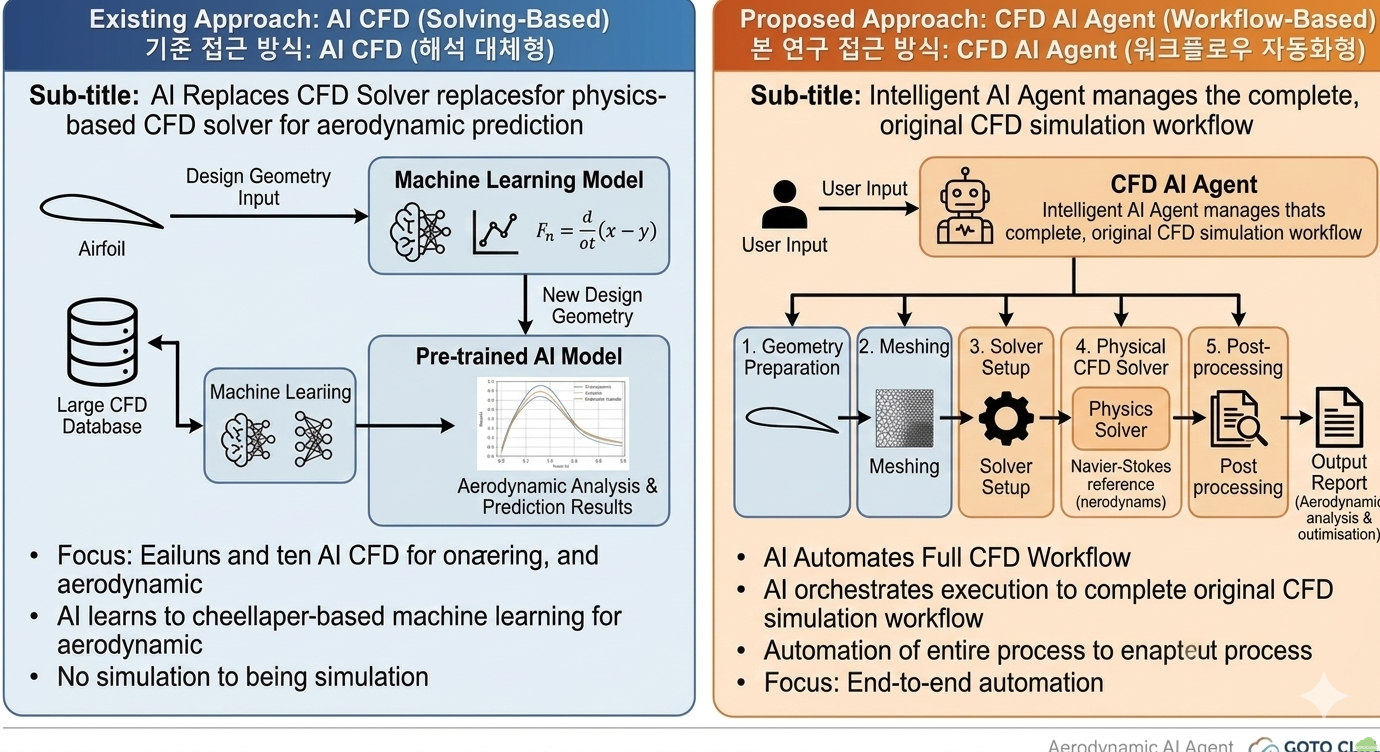
Current mainstream AI-CFD research focuses heavily on Solving-Based approaches, such as Surrogate Modeling or Physics-Informed Neural Networks (PINNs). While accelerating the solver is impressive, it often results in a “local optimization” that ignores the broader engineering reality.
The Critical Limitations:
- The 80/20 Bottleneck: According to the NASA CFD Vision 2030 Study, approximately 80% of the total engineering cycle time is consumed by geometry preparation and meshing, not the solver itself. Reducing solver time to zero only addresses a fraction of the problem.
- Workflow Fragmentation: Even with a fast AI solver, an engineer must still manually clean CAD data, generate meshes, and set boundary conditions.
- The Trust Gap: Surrogate models lack the inherent physical guarantees of Navier-Stokes solvers, often requiring manual “sanity checks” that re-introduce human labor.
3. The Paradigm Shift: CFD AI-Agent (Workflow-Based)
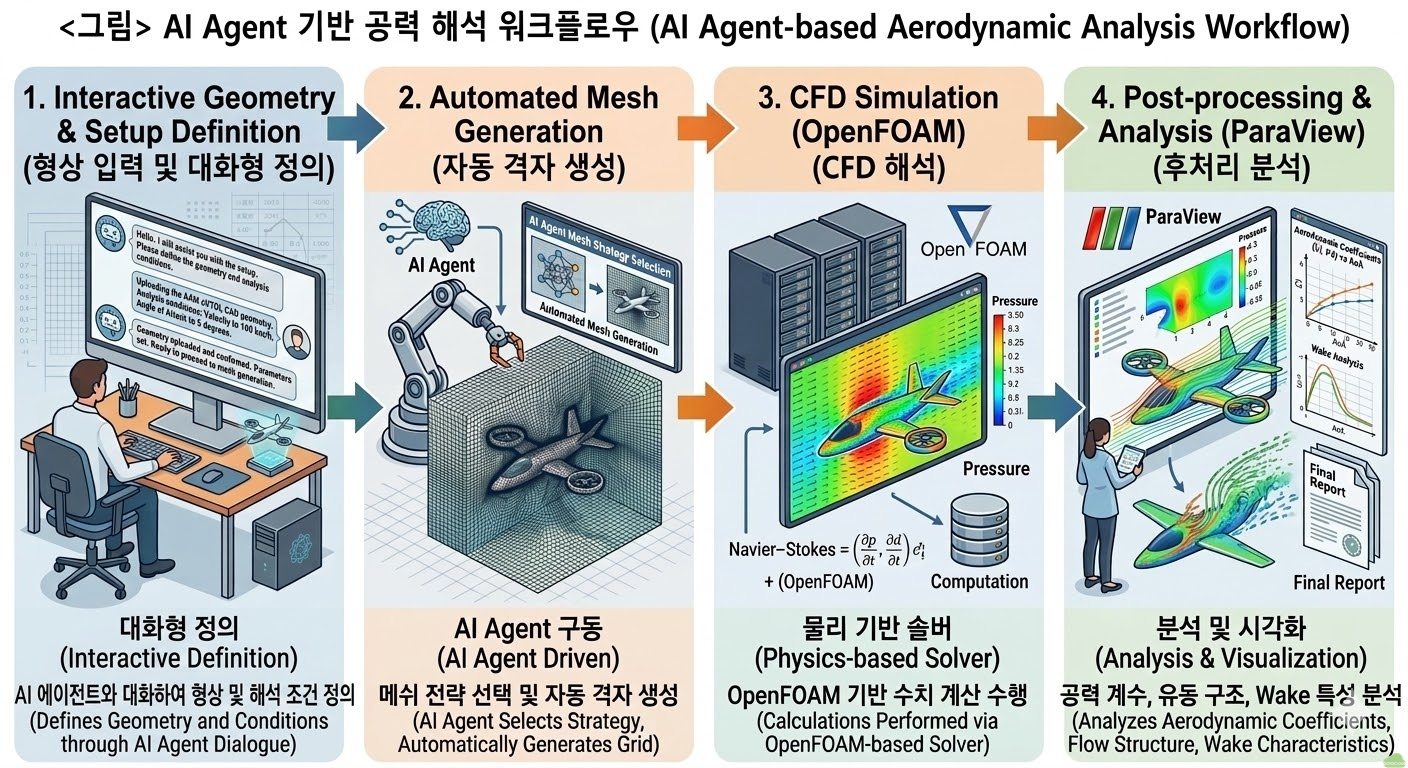
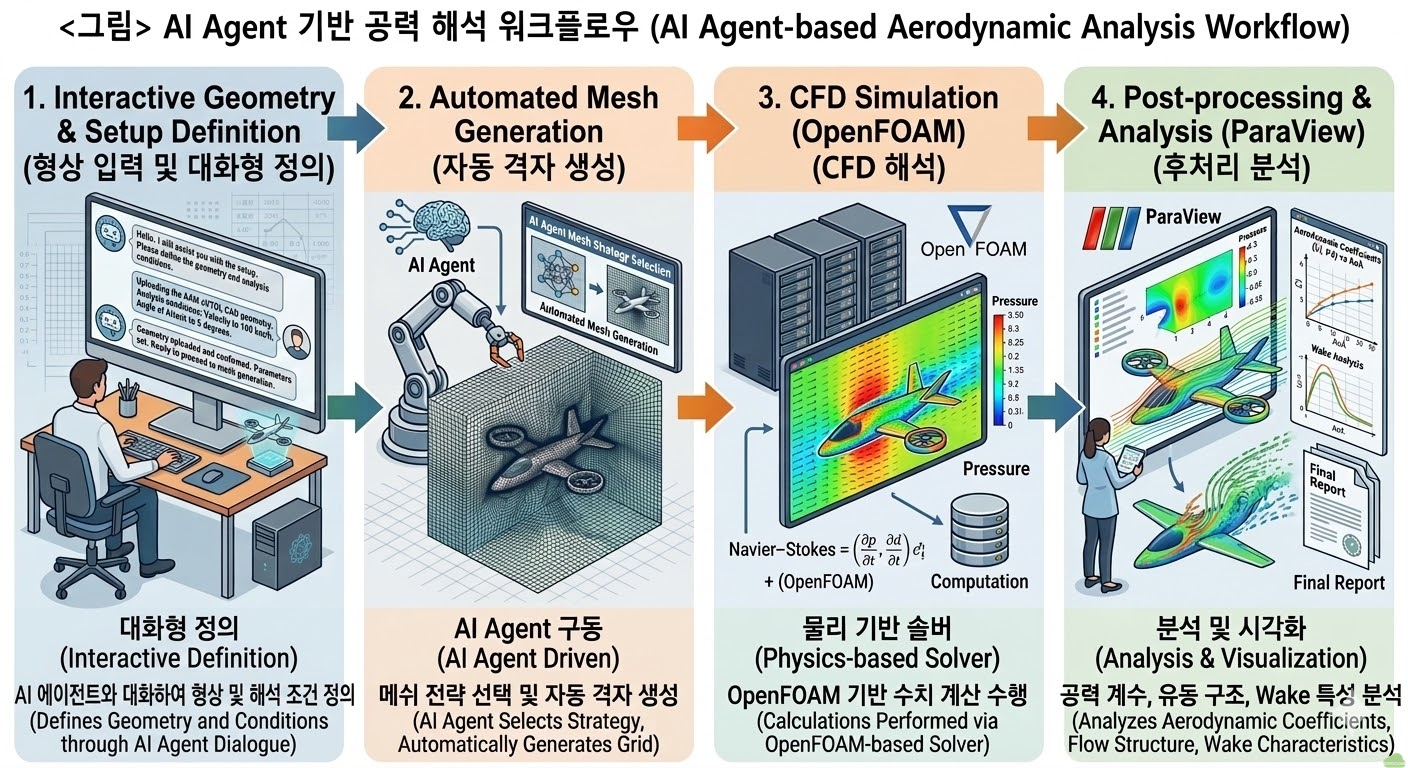
This research proposes a move toward the CFD AI-Agent—an Intelligent Orchestrator that manages the complete, original CFD simulation workflow rather than replacing the physics.
Why the CFD AI-Agent Wins:
- End-to-End Automation: The Agent acts as a digital engineer, autonomously navigating through Geometry Setup (Modler), Automated Meshing(Msher), Physics-Based Solving (Solver), and Post-processing (Post Processor).
- Preserved Physical Integrity: By keeping the physics-based solver intact, we maintain 100% reliability and adherence to Navier-Stokes equations, avoiding the “black box” risks of surrogate models.
- Maximizing Engineering Throughput: The focus shifts from Tsolve to the total time Ttotal.
Ttotal=Tpre+Tsolve+Tpost
By automating the Tpre and Tpost stages (the 80%), the AI Agent delivers a much higher impact on organizational productivity than a faster solver ever could.
Conclusion: Flow Over Speed
Just as Microsoft expanded the definition of HPC from “Performance” to “Productivity,” we must evolve AI-CFD from “Acceleration” to “Autonomy.” The future of aerodynamics does not lie in AI mimicking physics, but in AI mastering the workflow. By removing the mechanical friction of the toolchain, the CFD AI Agent allows engineers to focus on the essence of design, finally bridging the “Productivity Gap” identified decades ago.
References
- Microsoft Corporation (2005). White Paper: Windows Compute Cluster Server 2003 – HPC for the Masses.
- Gates, B. (2005). Keynote Address at the SC05 Conference, Seattle, WA.
- Internal Research Documentation (2026). Comparison of AI CFD and CFD AI-Agent Frameworks.
- Slotnick, J. P., et al. (2014). CFD Vision 2030 Study: A Year One Systems Catalog. NASA/TM—2014-218178.